
ROYAL FAMILY
WAIT… WHAT…?! Meghan Markle Shares First Public Photo of Lilibet — But Her Fiery Red Hair Has Britain Asking Questions!…. Turns Out….

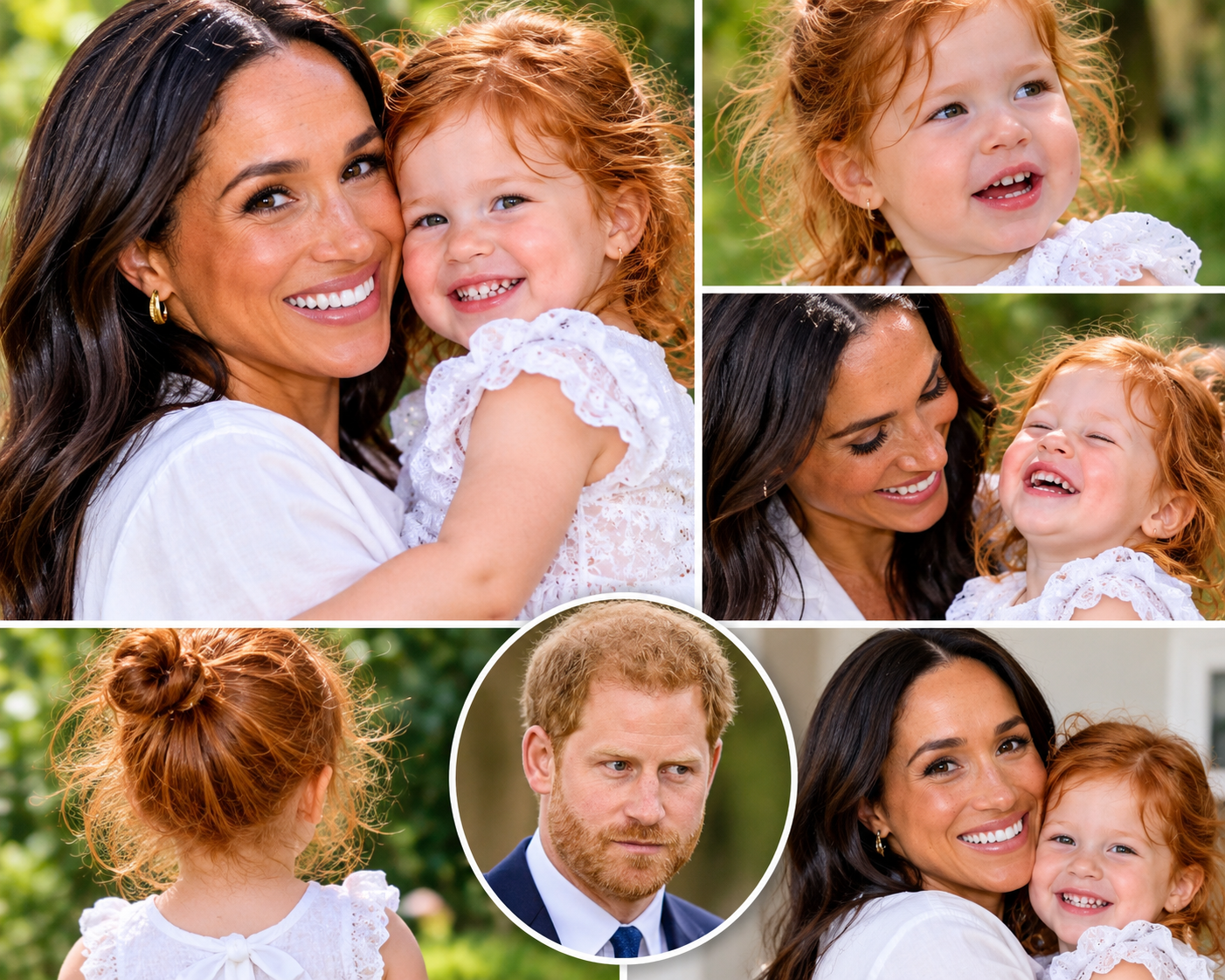
A photograph can sometimes speak louder than a thousand words, and a single family picture can spark conversations that nobody expected. That is exactly the kind of reaction surrounding the latest headline about Meghan Markle and her daughter, Princess Lilibet. The little girl’s striking red hair has become the centre of online curiosity, with royal watchers discussing family resemblance, genetics, and the remarkable features that make the young princess stand out.
But beyond the excitement surrounding the photograph, one question continues to attract attention: why has Lilibet’s appearance become such a talking point?
For years, Meghan Markle and Prince Harry have made deliberate efforts to protect their children’s privacy. Unlike Prince William and Kate Middleton, whose children occasionally appear at carefully selected royal engagements, Harry and Meghan have generally chosen to keep Archie and Lilibet away from the constant attention of public life.
That decision has attracted both admiration and criticism. Some people believe the Sussexes are right to give their children a childhood away from royal expectations, while others argue that their occasional family photographs naturally generate curiosity.
And now, the discussion surrounding Lilibet’s fiery red hair has added another layer to the ongoing fascination.
THE RED HAIR THAT HAS EVERYONE TALKING
One of the most noticeable features in the circulating images is the child’s beautiful reddish hair. Its distinctive colour has prompted many royal followers to discuss the family’s appearance and the possibility of inherited characteristics.
Prince Harry himself is famously known for his red hair, a feature that has long been associated with his side of the family. His mother, Princess Diana, also had family connections to reddish hair through her ancestry.
For many observers, Lilibet’s appearance is therefore an interesting reminder of how family traits can appear across generations.
But there is something else worth remembering: children can inherit characteristics from relatives several generations back. Hair colour, eye colour, facial features and even certain expressions can reflect a combination of family genetics.
In other words, there is no mystery that needs to be manufactured around a child’s appearance.
MEGHAN’S DECISION TO PROTECT HER CHILDREN
Meghan and Harry have repeatedly spoken about the importance of protecting their children from excessive media attention.
Their experience with the British royal establishment and the international press has clearly influenced how they approach parenthood.
For Meghan, motherhood has also been an important part of her public identity. Although she occasionally shares glimpses of family life, she has generally avoided making her children regular features of celebrity publicity.
This approach has created an unusual situation. Every rare photograph attracts enormous attention, and even the smallest visible detail can become a subject of online debate.
Some supporters say Meghan deserves credit for maintaining boundaries. They argue that Archie and Lilibet should be allowed to grow up without feeling that their every appearance must satisfy public curiosity.
Others believe that once members of the royal family become international public figures, interest in their children is almost inevitable.
The disagreement reflects a much larger conversation about celebrity parenting, royal responsibility and the right of children to privacy.
PRINCE HARRY’S FAMILY CONNECTION
Prince Harry’s relationship with his children has also remained an important part of the public conversation surrounding the Sussex family.
Since stepping back from their senior royal duties in 2020, Harry and Meghan have established a different lifestyle in California.
Their decision changed their relationship with the monarchy and created a new chapter for their family.
Harry has spoken publicly about wanting his children to have opportunities and experiences that allow them to develop their own identities.
For him, fatherhood represents something deeply personal. His experiences growing up under intense public scrutiny have influenced his views about raising children.
It is understandable, therefore, that photographs involving Lilibet attract attention. People are curious about the young princess because she represents the next generation of a family that has fascinated the world for decades.
However, curiosity should never become an excuse for invasive speculation.
WHY THE BRITISH PUBLIC IS DIVIDED
The British public has never had one single opinion about Meghan Markle.
Some admire her independence, charitable interests and willingness to challenge traditional expectations. Others remain critical of her decisions and her relationship with the royal institution.
Prince Harry’s departure from royal duties intensified those disagreements.
Consequently, even an ordinary family photograph can become part of a much bigger debate.
Supporters may see a loving mother enjoying a special moment with her daughter. Critics may question the timing or public presentation of the photograph. Meanwhile, neutral observers may simply appreciate seeing a rare glimpse of a family that usually maintains considerable privacy.
But should a little girl’s hair colour really become another battleground in an already complicated royal debate?
That is perhaps the more interesting question.
THE GENETICS BEHIND LILIBET’S APPEARANCE
Red hair is a naturally occurring genetic characteristic, often associated with variations in the MC1R gene. It can appear in families even when parents do not both have visibly red hair.
This means that a child’s appearance cannot be used as reliable evidence for sensational claims about family relationships.
Prince Harry’s unmistakable red hair makes the family resemblance discussion understandable. It is also a reminder that inherited characteristics can be fascinating without requiring controversy.
Lilibet does not need to look exactly like her mother or father to belong to her family.
Every child is a unique combination of inherited characteristics, personality and individual development.
And perhaps that is what should matter most.
WHAT DOES THIS MEAN FOR THE ROYAL FAMILY?
Although Lilibet and Archie are growing up outside the traditional royal household, their family connections continue to attract international interest.
Their grandfather, King Charles III, remains an important figure in the wider family story. Their uncle, Prince William, is also central to the future of the British monarchy.
The relationship between the Sussexes and the rest of the royal family has experienced considerable difficulties, and questions about reconciliation frequently return to the headlines.
However, the children should not be expected to carry the weight of those disagreements.
They are young, and their future should be determined by their parents’ decisions and their own choices as they grow older.
Whether they eventually become more involved in royal life or continue following a private path remains to be seen.
THE BIGGER QUESTION: CAN LILIBET HAVE A NORMAL CHILDHOOD?
Perhaps the most important issue raised by the attention surrounding Lilibet is not her hair colour, her resemblance to relatives or the endless online discussions.
It is whether the daughter of Prince Harry and Meghan Markle can enjoy the ordinary childhood that her parents say they want for her.
Growing up with such a famous family name presents unique challenges. Public curiosity may follow her for years, regardless of whether she chooses a public life.
That is why boundaries matter.
A photograph can be appreciated without demanding access to every private family moment. A child’s appearance can be discussed without turning it into an accusation or an elaborate conspiracy.
Ultimately, Lilibet is a little girl, not a royal controversy.
And while the world may continue discussing her striking red hair, the most meaningful thing is that she grows up surrounded by love, security and the freedom to become her own person.
So, what do you think? Should Meghan and Harry share occasional family photographs, or should they keep Archie and Lilibet completely away from public attention? And does Lilibet’s red hair remind you more of Prince Harry’s side of the family?
One thing is certain: the debate over royal privacy is unlikely to disappear anytime soon.

ROYAL WAR ERUPTS! KING CHARLES REPORTEDLY FACES PRESSURE TO STRIP PRINCE HARRY OF HIS TITLE AND ERASE HIS NAME FROM THE ROYAL WEBSITE — BUT THE ONE SHOCKING DETAIL THAT COULD CHANGE EVERYTHING HAS LEFT ROYAL FANS ASKING…?

WAIT… WHAT…?! Meghan Markle Shares First Public Photo of Lilibet — But Her Fiery Red Hair Has Britain Asking Questions!…. Turns Out….

Breaking news;Prince William, 44, spotted kissing mysterious woman, 28, during an intimate and romantic UK vacation without wife Kate Middleton, 44, as her frequent hospital visits raise fresh concerns about her health, but one shocking detail in the photo raises big questions

💔👨👦👦 “I WILL NOT SACRIFICE MY SON’S FUTURE JUST TO KEEP THE PALACE AT PEACE!” — PRINCE HARRY’S DEFIANT STANCE REPORTEDLY LEAVES KING CHARLES III STUNNED BEHIND CLOSED DOORS! Everyone believed the private summit was intended to resolve long-standing legal and security disputes, until Harry reportedly stood his ground with a fierce declaration — and made an unexpected demand concerning Archie and Lilibet that left everyone in the room speechless… 👇👇

King Charles Looks Completely Furious, Visibly Screaming at Queen Camilla as They Leave the Royal Albert Hall Following the 2026 Royal Variety Performance! But What Cameras Captured During Their Tense Exchange Has Left Royal Fans Stunned, Raising Serious Questions About What Really Happened Behind Palace Doors.

CAMERA CAUGHT — MEGHAN MARKLE UNEXPECTEDLY SHARES NEVER-BEFORE-SEEN FAMILY PHOTOS AFTER SECRET SCOTTISH GETAWAY… BUT EAGLE-EYED FANS IMMEDIATELY SPOTTED ONE STRIKING DETAIL IN THE NEWLY RELEASED PHOTO HAS NOW SPARKED A WAVE OF DISCUSSION ONLINE… 👇👇

ROYAL FANS LEFT SPEECHLESS!Queen Camilla’s Expression Changes as King Charles Appears Frustrated During Their Dramatic Departure! The Tense Footage Is Raising Eyebrows and Sparking One BIG Question About What Is Really Happening Behind Palace Walls!!

🚨😱UNBELIEVABLE SCENES — ONLY HALF AN HOUR AGO AT A LOCAL RESTAURANT! HIDDEN CAMERA FOOTAGE CAPTURES HARRY AND MEGHAN HAVING A FIERCE ROW. THE UK PUBLIC WAS LEFT SPEECHLESS ONCE LIP-READING SPECIALISTS TRANSLATED THEIR HEATED EXCHANGE. AS IT TURNS OUT, THE WHOLE ARGUMENT BEGAN BECAUSE MEGHAN HAD SECRETLY PLANNED TO…👇👇👇

🚨🔥 TRUMP GETS BOOED LOUDLY AT NFL GAME — BUT WAIT UNTIL YOU SEE WHAT HIS AIDE NATALIE HARP DID RIGHT BESIDE HIM! MELANIA WAS NOWHERE IN SIGHT, AND ONE UNEXPECTED CAMERA MOMENT HAS EVERYONE ASKING QUESTIONS! WHAT IS REALLY GOING ON?

🔥Prince Harry & Mysterious 35-Year-Old Woman Set The Yacht On Fire With Steamy Romantic Moments,Meghan Markle Is Nowhere to Be Seen, BUT WAIT! One Unexpected Detail From Their Romantic Encounter, These Intimate Photos Have Fans Talking! 😍❤️👑

“Taylor Swift and Travis Kelce Spotted Sharing Intimate Moments on a Boat in France! Cameras Captured Their Every Move, and Fans Can’t Stop Talking About What They Saw. “
