
CELEBRITY
The United States is offering a reward of up to $20 million for information about Iran’s nuclear program, despite US President Donald Trump’s repeated claims to have obliterated Tehran’s capabilities.

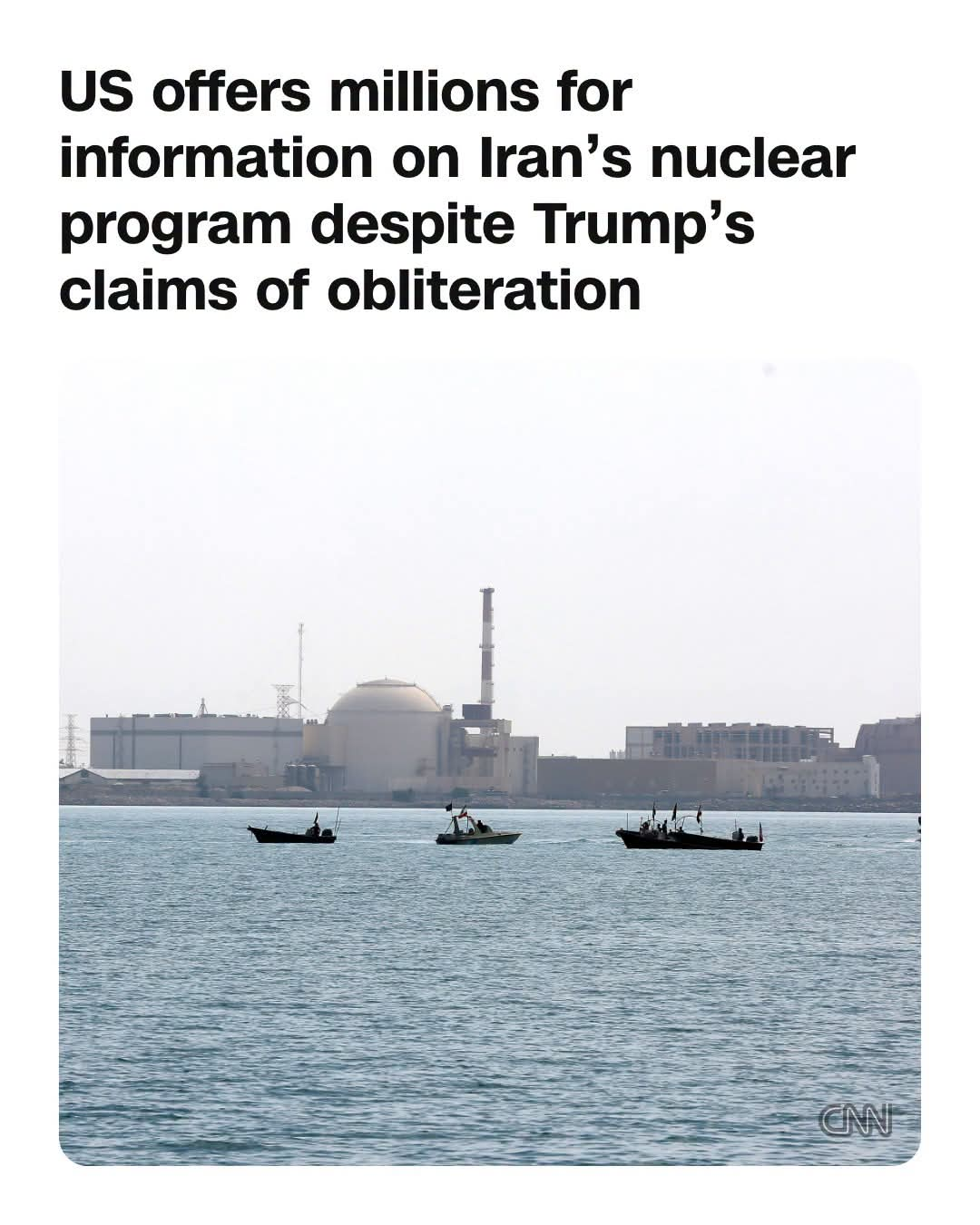
BREAKING: US Offers $20 MILLION Reward for Information on Iran’s Nuclear Programme as Trump’s ‘Completely Obliterated’ Claims Face Fresh Questions
Washington’s latest move has sparked international debate after President Donald Trump repeatedly declared that American military strikes had completely destroyed Iran’s nuclear capabilities.
The United States has announced a reward of up to $20 million for anyone who can provide valuable information about Iran’s nuclear programme, a development that has attracted widespread attention and raised fresh questions about the actual extent of the damage caused by previous American military operations.
The announcement was made public on Friday, November 6, 2026, by US Central Command (CENTCOM), which confirmed that the State Department’s Rewards for Justice programme is seeking intelligence about Iranian nuclear facilities, equipment and individuals associated with the country’s nuclear activities.
The reward also comes with the possibility of relocation for individuals who provide qualifying information.
What makes the announcement particularly significant is its timing. Trump has repeatedly insisted that American forces successfully obliterated Iran’s nuclear infrastructure during military operations, presenting the strikes as a major achievement in preventing Tehran from developing nuclear weapons.
However, Washington’s decision to offer millions of dollars for information about the same programme has prompted renewed discussion about what American intelligence agencies still do not know.
WHAT EXACTLY IS THE UNITED STATES LOOKING FOR?
According to the announcement, American authorities are interested in information about the locations of Iranian nuclear facilities, equipment used in nuclear activities, and individuals connected to the programme, including members of Iran’s scientific community.
The government is also seeking information about the movements of these facilities, equipment and associated personnel.
The Rewards for Justice programme, established in 1984, offers financial incentives to individuals who provide information that helps protect American national security interests.
Although the maximum reward has been set at $20 million, authorities have not disclosed precisely what information would qualify an informant for the full amount.
WHY IS WASHINGTON STILL SEEKING INFORMATION?
One of the biggest issues highlighted by the US government concerns what the International Atomic Energy Agency (IAEA) describes as a loss of continuity of knowledge.
The agency has experienced difficulties maintaining a complete picture of Iran’s production and inventory of important nuclear components, particularly centrifuges.
Centrifuges are specialised machines used to enrich uranium, a process that can support civilian nuclear energy programmes but can also produce material suitable for nuclear weapons.
The lack of reliable information about certain components makes it more difficult for international inspectors to establish exactly what Iran possesses, where its equipment is located and how its nuclear capabilities may have changed.
This uncertainty is one of the reasons Washington continues to seek additional intelligence.
THE 60% URANIUM ENRICHMENT CONCERN
Another major concern involves Iran’s highly enriched uranium stockpile.
Before the current crisis, the IAEA reported that Iran had accumulated uranium enriched to 60% purity.
Weapons-grade uranium is generally enriched to approximately 90%, although reaching 60% does not automatically mean a country has developed a nuclear weapon.
Nevertheless, the stockpile has remained a major concern for Western governments because further enrichment could bring the material closer to weapons-grade levels.
Recent reporting has also highlighted concerns about underground facilities and the possibility that important nuclear materials and equipment may have survived previous attacks.
PICKAXE MOUNTAIN ADDS ANOTHER DIMENSION
Attention has also turned towards a suspected underground nuclear site known as Pickaxe Mountain in central Iran.
Trump recently suggested that the location remained among the targets Washington was concerned about.
The facility has attracted attention because of allegations that Iran could be using underground infrastructure to protect sensitive nuclear equipment and activities.
Iran, however, disputes the characterisation of the location as a nuclear facility.
The issue illustrates why the United States may continue seeking intelligence even after conducting extensive military operations.
Destroying buildings and infrastructure does not necessarily establish that every nuclear material stockpile, technical capability or piece of specialised equipment has been eliminated.
TRUMP’S CLAIMS AND THE QUESTIONS NOW FACING WASHINGTON
Trump has repeatedly defended the effectiveness of American military strikes, maintaining that Iran has been prevented from obtaining nuclear weapons.
His administration has also continued to describe preventing an Iranian nuclear weapon as a central objective of its policy towards Tehran.
However, the latest $20 million reward announcement highlights the intelligence gaps that remain.
It does not independently prove that Iran’s nuclear programme is fully operational, nor does it establish that previous American strikes failed. Instead, it demonstrates that Washington still considers information about Iran’s nuclear infrastructure important to its national security.
WHAT HAPPENS NEXT?
The announcement comes amid continuing tensions between Washington and Tehran, with diplomatic mediators attempting to find a way forward.
Iranian President Masoud Pezeshkian has indicated that his government remains interested in resolving the crisis through dialogue, while Trump has also claimed that Tehran wants an agreement.
Whether the reward produces significant new intelligence remains to be seen.
For now, the United States is offering as much as $20 million for information that could help it understand Iran’s nuclear programme.
And that leaves an important question at the centre of the international debate:
If America’s military strikes completely destroyed Iran’s nuclear capabilities, why does Washington still need millions of dollars’ worth of information about the programme?
The answer may lie in the difference between destroying known facilities and establishing exactly what remains.
What is your opinion? Is the United States simply gathering intelligence to ensure Iran never rebuilds its nuclear programme, or does Washington still have unanswered questions about the extent of the damage? Share your thoughts below.

The United States is offering a reward of up to $20 million for information about Iran’s nuclear program, despite US President Donald Trump’s repeated claims to have obliterated Tehran’s capabilities.

BREAKING NEWS: Trump has completely broken down, after Trump’s speech tonight, they accidentally forgot to turn off the camera and captured this

John Cena shares pictures of himself chilling with his sugar queen mama, leaving fans in shock. He says he has always had love for older women, even back in his 20s. “The older the cake, the sweeter the taste!”

😳 YOU WON’T BELIEVE THIS!Grego Rossello shared the strangest thing someone did to him in bed and left everyone in shock: “My computer shut down

💔HEARTBREAKING:Denisse González was hospitalized for the fifth time and worried her followers: “The road is long”

Georgina Rodríguez, Ronaldo’s wife, went to the beach alone to get some fresh air. Cristiano Ronaldo couldn’t join her because he was busy at the gym. This is the first time she has shown off her baby bump.

Larsa Pippen reveals she was diagnosed with potentially life-threatening brain aneurysm

Doomed Learjet passenger made devastating final call to sister before plane crashed, killing 9

Alanis Morissette comes out as pansexual

Rihanna has just ended her relationship with A$AP Rocky after discovering that he secretly had DNA tests carried out on their three children without her knowledge.

🔥 AWKWARD MOMENT! HARRY GETTING UNUSUALLY CLOSE TO A MYSTERY WOMAN RIGHT IN FRONT OF MEGHAN — A WHISPERED REMARK SENDS SOCIAL MEDIA INTO A FRENZY! 😱👇👇 DISCOVER THE MYSTERIOUS REMARK THAT HAS SENT SOCIAL MEDIA INTO A FRENZY BELOW!
