
CELEBRITY
Breaking news: Donald Trump 🇺🇸: “If China touches Taiwan, we will destroy its entire naval fleet and cripple Beijing’s economy within 24 hours Xi Jinping 🇨🇳: “Stay where you are, Washington. Taiwan is ours. If the United States intervenes, our hypersonic missiles will turn your territory to ashes…Show ⤵️

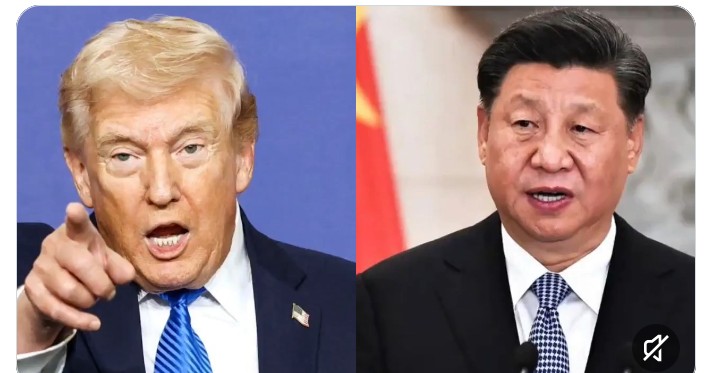
BREAKING: TRUMP AND XI JINPING FACE A DANGEROUS SHOWDOWN OVER TAIWAN – COULD THE WORLD BE HEADING TOWARD A MAJOR MILITARY CRISIS?
The world is watching closely as tensions between the United States and China continue to raise concerns over the future of Taiwan. With Donald Trump leading Washington and Xi Jinping maintaining Beijing’s position, one of the most sensitive geopolitical disputes in the world remains unresolved.
At the centre of the controversy is Taiwan, a self-governing island that China considers part of its territory but whose government rejects Beijing’s sovereignty claims.
The stakes are enormous, and any serious military confrontation could have consequences far beyond Asia.
XI JINPING’S WARNING TO THE UNITED STATES
During his May 2026 meeting with Trump in Beijing, Xi Jinping reportedly delivered a particularly firm message about Taiwan.
According to China’s official account, Xi warned that mishandling the Taiwan question could lead to clashes and even conflicts between the two countries.
He described Taiwan as the most important and sensitive issue in US-China relations.
Beijing has repeatedly insisted that Taiwan is part of China and has not ruled out using force to achieve reunification.
The Chinese government also opposes American weapons sales to Taiwan, arguing that such assistance encourages independence.
TRUMP’S RESPONSE AND WASHINGTON’S STRATEGY
Trump has maintained a complicated position on Taiwan.
The United States does not have formal diplomatic relations with Taiwan, but Washington remains its most important international security partner and largest arms supplier.
Following his May meeting with Xi, Trump revealed that the Chinese president had directly asked whether America would defend Taiwan if China attacked.
His response was particularly noteworthy.
Trump declined to reveal what the United States would do, saying that he would not publicly discuss the question.
That answer reflects Washington’s longstanding policy of strategic ambiguity.
Rather than promising automatic military intervention, the United States maintains uncertainty about its precise response to a potential Chinese attack.
CHINA’S MILITARY POWER RAISES CONCERNS
China has invested enormous resources in developing its military capabilities.
Its expanding navy, advanced aircraft, missile systems, and hypersonic weapons have attracted considerable international attention.
These developments have become particularly important as military competition between Washington and Beijing intensifies.
American military planners are also strengthening their capabilities across the Indo-Pacific region.
However, neither country has publicly declared an intention to begin a war over Taiwan.
WHY TAIWAN MATTERS SO MUCH
Taiwan is strategically important for several reasons.
First, its geographical position makes it central to security calculations across the western Pacific.
Second, Taiwan plays an enormous role in the global semiconductor industry.
Its advanced chip manufacturing capabilities support industries ranging from smartphones and computers to artificial intelligence and automobiles.
A military confrontation could disrupt international shipping routes, damage supply chains, and create significant economic uncertainty.
Countries including Japan, Australia, and the Philippines would also have important security concerns.
COULD THIS DISPUTE BECOME A WAR?
The possibility of military conflict remains one of the biggest concerns surrounding US-China relations.
However, both countries understand that a direct confrontation could carry devastating economic and military consequences.
Diplomatic negotiations, military communication, and regional cooperation remain important tools for preventing escalation.
The challenge is finding a way to maintain peace while addressing fundamentally different positions on Taiwan’s future.
For now, the situation remains closely watched by governments, investors, military analysts, and ordinary citizens around the world.
THE BIG QUESTION: If China attempts to take Taiwan by force, will Washington intervene, or will Trump seek a diplomatic agreement with Xi Jinping to prevent a wider conflict?
The future of Taiwan could have consequences for the entire world.

The United States is offering a reward of up to $20 million for information about Iran’s nuclear program, despite US President Donald Trump’s repeated claims to have obliterated Tehran’s capabilities.

BREAKING NEWS: Trump has completely broken down, after Trump’s speech tonight, they accidentally forgot to turn off the camera and captured this

John Cena shares pictures of himself chilling with his sugar queen mama, leaving fans in shock. He says he has always had love for older women, even back in his 20s. “The older the cake, the sweeter the taste!”

😳 YOU WON’T BELIEVE THIS!Grego Rossello shared the strangest thing someone did to him in bed and left everyone in shock: “My computer shut down

💔HEARTBREAKING:Denisse González was hospitalized for the fifth time and worried her followers: “The road is long”

Georgina Rodríguez, Ronaldo’s wife, went to the beach alone to get some fresh air. Cristiano Ronaldo couldn’t join her because he was busy at the gym. This is the first time she has shown off her baby bump.

Larsa Pippen reveals she was diagnosed with potentially life-threatening brain aneurysm

Doomed Learjet passenger made devastating final call to sister before plane crashed, killing 9

Alanis Morissette comes out as pansexual

Rihanna has just ended her relationship with A$AP Rocky after discovering that he secretly had DNA tests carried out on their three children without her knowledge.

🔥 AWKWARD MOMENT! HARRY GETTING UNUSUALLY CLOSE TO A MYSTERY WOMAN RIGHT IN FRONT OF MEGHAN — A WHISPERED REMARK SENDS SOCIAL MEDIA INTO A FRENZY! 😱👇👇 DISCOVER THE MYSTERIOUS REMARK THAT HAS SENT SOCIAL MEDIA INTO A FRENZY BELOW!
