
CELEBRITIES
REPORT: The Supreme Court Blocks Donald Trump’s “Save Act,” Rules It Violates U.S. Constitution, Conflicts With Voting Rights Act, and Imposes Unreasonable Burdens on Voters

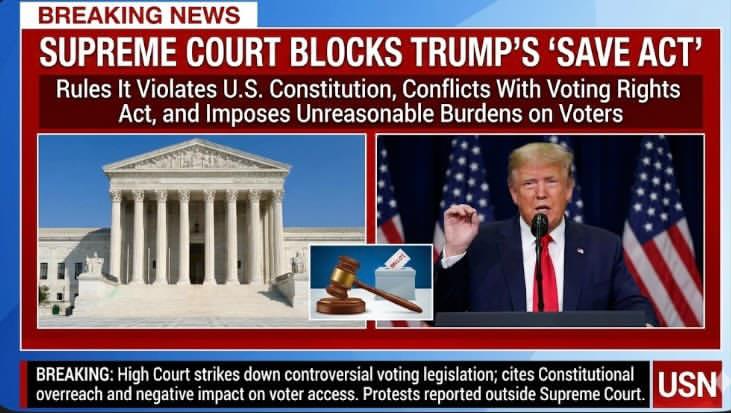
In a major rebuke to former President Donald Trump’s election agenda, the U.S. Supreme Court has blocked enforcement of the so-called “SAVE Act,” concluding—according to a newly released report—that the measure violates the U.S. Constitution, conflicts with the Voting Rights Act, and places unreasonable burdens on eligible voters.
Why the Court Intervened
The report outlines three central failures that proved decisive:
1. Constitutional Violations
The Court found that key provisions of the SAVE Act overstepped federal authority and intruded on powers reserved to the states, while also threatening core constitutional protections tied to equal access and due process in federal elections.
2. Conflict With the Voting Rights Act
Justices determined that the law ran headlong into the Voting Rights Act by disproportionately impacting minority, elderly, low-income, and first-time voters—groups the VRA was explicitly designed to protect from discriminatory barriers.
3. Unreasonable Burdens on Voters
The SAVE Act imposed strict documentation and procedural requirements that, according to the report, would have blocked lawful voters from the ballot without sufficient evidence of widespread fraud to justify such measures. The Court emphasized that election security cannot come at the expense of fundamental voting rights.
A Broader Message From the Court
Beyond the immediate ruling, the decision sends a clear signal: claims of election integrity must be backed by evidence, not fear or political strategy. The Court rejected the premise that speculative risks justify sweeping restrictions that make voting harder for millions of Americans.
Political Fallout
The ruling is already reverberating through Washington. Voting-rights advocates hailed it as a landmark defense of democracy, while Trump allies denounced it as judicial overreach. Analysts say the decision sharply narrows the path for future federal attempts to impose blanket voting restrictions under the banner of “election security.”
What Comes Next
With the SAVE Act blocked, states retain their existing election frameworks—subject to long-standing federal protections. Legal experts expect the ruling to shape election law debates for years, reinforcing a constitutional line the Court appears unwilling to let Congress or future administrations cross.
Bottom line: The Supreme Court’s action underscores a foundational principle of American democracy—the right to vote cannot be curtailed without compelling justification, and safeguarding elections must never mean silencing voters.


🔥 BREAKING: TRUMP GOES NUTS After JIMMY KIMMEL and ARNOLD SCHWARZENEGGER BLAST HIM on LIVE TV — STUDIO STUNNED, THEN ERUPTS ⚡ What began as a standard late-night segment instantly turned explosive when Jimmy Kimmel welcomed Arnold Schwarzenegger and calmly set the stage. No shouting. No theatrics. Just a perfectly timed setup — and then the words landed. The studio froze. A long, uncomfortable pause followed as the audience absorbed what was said. Then the reaction hit — loud, sharp, uncontrollable. Laughter and gasps rolled through the room as Kimmel let the moment breathe. No piling on. No overkill. One clean line was enough. According to sources, Trump was watching live — and completely LOST IT. Insiders say he erupted behind the scenes, pacing, firing off calls, and demanding the segment be taken down. The reaction reportedly dragged on well after the show ended. Clips from the exchange are now racing across social media, racking up massive views as commenters call it one of the most brutal late-night moments of the year. Observers note: Kimmel and Schwarzenegger didn’t rant — they let the contrast speak for itself. 👇 The clip is spreading fast — watch the moment that sent Trump into full meltdown before it disappears⤵️

REPORT: The Supreme Court Blocks Donald Trump’s “Save Act,” Rules It Violates U.S. Constitution, Conflicts With Voting Rights Act, and Imposes Unreasonable Burdens on Voters

REPORT: The Supreme Court Blocks Donald Trump’s “Save Act,” Rules It Violates U.S. Constitution, Conflicts With Voting Rights Act, and Imposes Unreasonable Burdens on Voters

JUST IN: Supreme Court Overturns Donald Trump’s Immigration Detention Policy, Ruling It Unlawful and Raising Serious Concerns Over ICE Brutality

🚨 BREAKING: Here’s why the decision by the Clinton family to agree to testify publicly is being described by observers as so radical—and so unexpected. In a political culture where silence and legal maneuvering are the norm, voluntarily stepping into the spotlight changes the entire dynamic. According to analysts, this move isn’t about spectacle—it’s about control of the narrative. By agreeing to testify, the Clintons signal confidence and transparency, flipping the usual script where powerful figures fight to avoid public questioning. That alone has shifted the conversation across Washington. What makes this moment stand out is timing. With tensions already high and scrutiny intensifying, choosing openness over avoidance raises the stakes for everyone involved. Supporters see it as bold. Critics see it as risky. Either way, it forces answers into the open—and that’s why this move is resonating so loudly right now. 👇👇

💥 TRUMP ERUPTS as Calls for Him to Step Aside Surge Nationwide — Public Anger Boils Over, White House Under INTENSE PRESSURE 🔥 A political shockwave is rippling across the country as frustration with Donald Trump hits a new peak. Polls, petitions, and viral campaigns are all amplifying the same message — enough is enough, and the demand for him to go is growing louder by the hour. What once felt like scattered discontent has swelled into a nationwide backlash, with protests spreading and public confidence visibly eroding. Sources close to Trump claim tensions flared behind closed doors at Mar-a-Lago, where emotions reportedly ran high as advisers scrambled to contain the fallout. Online, reactions are exploding — loyalists are digging in, while a noticeable wave of former supporters appears to be breaking away. Hashtags like #TrumpOutNow are surging across X and TikTok, fueled by clips, commentary, and raw political rage. The internet is locked onto this moment as pressure mounts and narratives collide. 👇 Dive into the polls, footage, and reaction driving this escalating showdown.

🚨 MAGA REELS AS CLINTONS SIGNAL WILLINGNESS TO TESTIFY, SHIFTING THE POLITICAL BALANCE ⚡ Republican-aligned circles are recalibrating after both Bill and Hillary Clinton indicated they are prepared to testify if formally requested, a move that cuts through months of deflection and procedural delay. What was long framed as speculation is now a concrete possibility, prompting legal teams to adjust strategy and messaging behind the scenes. As expectations rise and public scrutiny intensifies, supporters frame the move as transparency, while critics warn it could unravel carefully maintained narratives once statements are made under oath. The real consequences may depend on how this testimony unfolds—and what details emerge next.👇

🚨 He FACES Financial RUIN as Bank Evidence SHAKES NY Fraud Trial — Judge STOPS Defense Cold ⚖️🔥 At approximately 11:15 AM this morning, proceedings in the New York civil fraud trial took a dramatic turn when Judge Arthur Engoron abruptly halted the defense mid-argument. Observers say the judge intervened not out of anger, but to protect the integrity of the court record, after the defense advanced a claim that prosecutors and analysts described as legally untenable. 👇 See all below

Barack Obama EXPOSES a HIDDEN DETAIL LIVE — Trump GOES NUTS as the MOMENT TURNS CHAOTIC! ▶️ Watch the full moment⤵️

Federal Judge Issues Sweeping Temporary Restraining Order Halting ICE Operations Nationwide, Ignoring Strong Rejection From Donald Trump Administration, Raising Legal and Political Tensions

🚨 BREAKING: A survivor has come forward in a powerful new interview with Midas Touch Network, sharing previously unheard personal experiences related to the long-running Jeffrey Epstein case. The conversation, handled with care and restraint, is already drawing widespread attention online. Rather than making sweeping accusations, the survivor focused on first-hand perspective, emotional impact, and unanswered questions that have lingered for years. Viewers say the account was calm but deeply unsettling, shedding light on how silence, power, and fear shaped what happened behind closed doors. This isn’t sensationalism—it’s testimony. As clips circulate and reactions grow, many are calling the interview a reminder of why transparency matters and why these stories continue to resonate. The discussion is far from over, and the public response is only beginning to build. 👇👇
