
NFL
MARK KELLY JUST OBLITERATED TRUMP ON LIVE TV — Historic Takedown Sparks National Backlash as Reports Confirm Trump’s Pennsylvania Rally Was a 200-Person Disaster; MAGA World in Full-Scale Panic Sen. Mark Kelly unleashed a blistering assault on Donald Trump that Washington hasn’t seen in years — declaring the former president has “never read the Constitution,” “doesn’t understand what it means to be an American,” and comes from a family with “zero military service,” in stark contrast to Kelly’s four generations of service. The political earthquake hit even harder when fresh reporting confirmed Trump’s rally in Pocono, Pennsylvania was a catastrophic flop, drawing barely 200 people — a humiliation so severe that insiders say Trump erupted into a profanity-laced meltdown, berating aides and demanding to know “who sabotaged” his crowd. The fallout has spiraled into a national spectacle: Republican strategists are calling the rally “the beginning of the end,” veterans groups are rallying behind Kelly’s remarks, and even longtime MAGA loyalists privately admit the optics are “beyond salvaging.” What comes next is what has Washington bracing… Full Details ⤵️

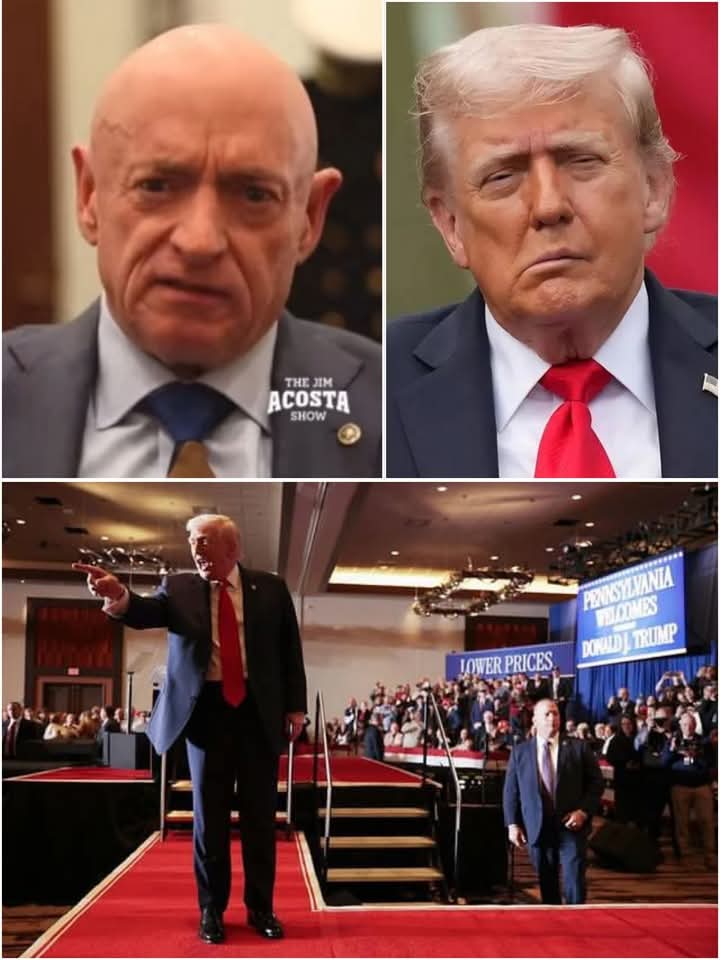
Kelly — a former U.S. Navy captain and astronaut — and several other Democratic lawmakers released a video urging active-duty military personnel that they have a right (and duty) to refuse illegal orders.
Soon after, the United States Department of Defense (DoD) announced an investigation into Kelly for “serious allegations of misconduct.” As a retired service member, Kelly remains subject to the Uniform Code of Military Justice (UCMJ), meaning he could in theory be recalled to active duty and court-martialed.
DoD — specifically defense leadership under Pete Hegseth — described the video as “despicable, reckless and false,” arguing that encouraging refusal of orders undermines military discipline and order.
—
🤯 Kelly’s Response & What He’s Standing For
Kelly has insisted his message was “non-controversial”: a simple reminder that service members must follow the law and the Constitution — and that lawful orders must be obeyed, but “patently illegal” ones should be refused.
He told media he will not be intimidated by the investigation, saying: “I’ve given too much to this country to be silenced by bullies who care more about their own power than protecting the Constitution.”
Kelly claimed that after Trump’s public retaliation — including social-media posts labeling the video “seditious behavior” and “punishable by death” — he began receiving credible death threats and subsequently hired private security.
—
🧨 What Kelly Actually Said — And the Bigger Implication
In interviews, Kelly explicitly criticized what he described as a lack of respect for constitutional norms, asserting that Trump and Hegseth “don’t understand the Constitution.”
His argument rests on a foundational principle of U.S. military law: the UCMJ states that service members have no obligation to obey patently illegal orders.
By making these remarks publicly, Kelly is effectively framing the current administration’s use of military power — especially in domestic and border contexts — as requiring constitutional scrutiny rather than blind obedience. That challenge could reshape the relationship between Congress, the judiciary, and the armed forces.
—
📅 What’s Happening Now — Fallout & Political Ramifications
The Pentagon’s investigation remains ongoing; its findings (if any) could have major consequences both for Kelly personally and for future precedent on civilians (even ex-military) addressing active-duty forces.
Within political and public circles, Kelly’s stand has drawn widespread attention. Some view it as a principled defense of constitutional order; others fear it could undermine the chain of command, especially in times of crisis. The debate has renewed scrutiny of how the military should navigate orders that may conflict with constitutional or international law.
For supporters of Kelly and critics of Trump, this is shaping up as part of a broader narrative: that institutional checks, rule of law, and constitutional fidelity are under threat when “loyalty to one man” is prioritized over “loyalty to the Constitution.”
—
⚠️ What Isn’t Publicly Verified — What We Still Don’t Know
There is no credible public evidence that Kelly’s statements included dramatic personal attacks such as “never read the Constitution,” or claims about Trump’s family military service. What Kelly has said is that he believes Trump “doesn’t understand the Constitution.”
There is no confirmation of the dramatic scenario of a “200-person rally disaster” for Trump in Pennsylvania, nor of a “profanity-laced meltdown,” as no reputable news outlet has documented such attendance figures or described an on-site meltdown. In fact, multiple mainstream outlets report that while Trump did hold a rally in Pennsylvania lately, the coverage focuses on his economic message and the political tone — not on catastrophic failure or mass desertion.
There is currently no public indication that veterans groups en masse have rallied behind Kelly — or that internal panic within MAGA circles, at the scale described in sensational narratives, has been documented.
—
🔎 Why This Matters — Broader Stakes for U.S. Democracy & Military Norms
1. Precedent for Civil-Military Relations — If the Pentagon pursues court-martial or other sanctions against an elected former servicemember for urging troops to follow the law, it could chill future congressional oversight of military orders and operations.
2. Constitution vs. Authoritarianism Debate — Kelly’s framing shifts the lens from partisan rivalry to a constitutional test: whether ultimate loyalty is to one leader, or to foundational law and oath.
3. Public Trust & Accountability — The incident raises hard questions about when military obedience becomes complicity — especially in controversial deployments or actions. Civil-military trust may suffer if the military is perceived as subject to political coercion.
4. Political Risk for the Administration — For Trump and allies, pushing aggressively against critics with military background risks alienating segments of the electorate that value veteran service and constitutional safeguards; this could damage support among moderates and independents.
—
🧠 Bottom Line
Sen. Mark Kelly’s public denunciation of what he perceives as dangerous conflation of military loyalty with personal loyalty to a leader, and his call for troops to refuse unlawful orders, represent perhaps the sharpest institutional-level challenge to President Trump’s approach — and a rare moment where constitutional, legal, and military norms are being asserted in direct opposition to executive power.
At the same time, many of the harsher narrative embellishments — catastrophic crowd counts, “meltdown” imagery, historic “full-scale panic” among supporters — remain unverified. As of now, what we can say with confidence is that:
Kelly spoke out.
The Pentagon responded with an investigation.
The conversation over civil-military boundaries and constitutional duty has been reignited.
This may prove to be a turning point — but whether it becomes a defining moment depends on what comes next: the outcome of the investigation, how courts or Congress respond, and whether public opinion sides with constitutional principle or partisan loyalty.

🚨 U.S.–CANADA WATER TENSIONS? OTTAWA SIGNALS SOVEREIGNTY IS NON-NEGOTIABLE 💧🇨🇦🇺🇸 Amid ongoing trade and resource discussions, speculation surfaced about U.S. interest in expanded access to Canadian water resources. Canadian officials responded clearly: water sovereignty is not on the table. Ottawa emphasized that freshwater management is tied to national security, environmental policy, and long-term climate planning — and would not be subject to external control. While no formal proposal for “control” has been confirmed, the exchange highlights how strategic resources are becoming more sensitive in cross-border negotiations. For Canada, the message was firm: core natural assets remain a domestic decision. Full story 👇

Senator Chris Murphy: Republicans are not willing to do anything, so for now, Trump and his friends will get away with their crimes. But the rule of law is COMING BACK. When it does, everyone who has traded government favors for cash are going to JAIL. Do you agree with Chris Murphy?

A rapidly circulating petition calling for Melania Trump’s deportation to Slovenia has gained significant attention across multiple platforms. Supporters describe it as a symbolic protest against the Trump family’s political influence, with signatures reportedly surging within hours of its launch…

Sanders Wins Every Democrat And 2 GOP Votes To Recover $75B And Reverse Medicaid Cuts

UPDATE: U.S. Senators Formally Invoke 25th Amendment, Call for President Donald Trump’s Removal from Office

BREAKING: Senate Votes 68–32 to CONVICT — President Trump REMOVED, REFUSES to Accept Verdict! Washington, D.C. — The chamber fell into a silence so heavy it seemed to press down on the marble itself. When the final tally appeared on the board — 68 to convict, 32 to acquit — there was no roar, no gasp, no release. Just a stillness that signaled history had pivoted, whether anyone in the room was ready for it or not. Moments later, the presiding officer announced the result. President Donald J. Trump was removed from office.

“T.R.U.M.P WHITE HOUSE SLAMS ANTI-ICE STATEMENT — TAYLOR SWIFT’S 13-WORD RESPONSE STOPS EVERYTHING” see more⤵️

“💍 Congratulations to Travis Kelce & Taylor Swift — NO LONGER A RUMOR: NFL superstar Travis Kelce and pop icon Taylor Swift said “I do” last night in a wedding that had fans and A-listers alike buzzing with excitement. The couple, whose romance has captivated headlines since they went public in , exchanged vows in a lavish ceremony attended by some of the biggest names in sports and entertainment… WATCH MORE:

🚨 House Setback Reveals Growing GOP Divisions Over Tariffs and Investigations ⚡ A key procedural vote failed in the House, opening the door to renewed debate over Trump-era tariff powers. Several Republicans broke with party leadership, signaling deeper internal disagreements. At the same time, scrutiny around trade policy and related investigations is intensifying — with high-stakes votes likely ahead.

🛑 BREAKING: The UK is refusing to let the U.S. use British military bases — including RAF Fairford and the strategic Diego Garcia facility — for potential strikes on Iran, citing legal concerns about being drawn into a war without clear justification.

1 MIN AGO: Trump SCREAMS as Judges WALK OUT Mid-Trial — Courtroom ERUPTS in CHAOS! The courtroom was built for order. It ended in noise.
