
CELEBRITIES
JUST IN: Supreme Court Set to Redefine the Limits of Presidential Immunity, Raising Serious Legal Stakes for President Donald Trump’s Second Term

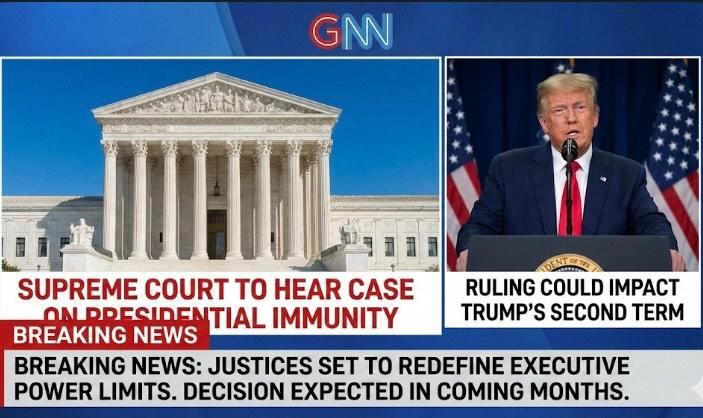
In a development with enormous constitutional and political implications, the U.S. Supreme Court is on track to revisit and possibly expand the doctrine of presidential immunity — a legal shield governing when a sitting or former president can be held accountable in court. The case centers on how far a president’s official actions are protected from criminal prosecution or judicial review, and its outcome could reshape the balance of power in Washington. �
SCOTUSblog +1
Why This Case Matters
At the heart of the controversy is Trump v. United States, a landmark 2024 ruling in which the Court held that presidents enjoy broad immunity for “official acts” — especially those tied to core constitutional functions — and presumptive protection for other actions within their official responsibilities. The Court’s conservative majority, led by Chief Justice John Roberts, found that former presidents cannot be prosecuted for certain types of official conduct, a decision hailed by allies of President Donald Trump but criticized by opponents as undermining the rule of law. �
Wikipedia
The justices stopped short of ruling that presidents are entirely above criminal liability, leaving unresolved exactly which acts qualify as “official” versus “unofficial.” That unresolved line — whether certain conduct falls within the scope of presidential authority — has become the subject of renewed litigation and impending Supreme Court review. �
SCOTUSblog
Second Term Legal Flashpoints
Now in his second term, President Trump’s legal team is pushing the boundaries of that immunity ruling as they seek to derail ongoing criminal and civil cases against him. Recent motions attempt to leverage presidential immunity arguments to erase or shift convictions — including efforts related to Trump’s 2024 state hush-money conviction — into federal courts where immunity claims might offer a path to dismissal or reversal. �
ABC News +1
Federal judges have signaled serious legal questions about these arguments, even as they acknowledge the constitutional complexity raised by the Supreme Court’s precedent. These maneuvers keep Trump’s high-profile legal battles alive and ensure that the question of immunity will continue to rise through the federal courts. �
https://www.29news.com
Broader Constitutional Implications
Legal experts warn that a further expansion of presidential immunity could dramatically reshape the separation of powers, giving future presidents broader authority with fewer legal constraints. This is especially consequential in an era when judges have repeatedly faced executive challenges to immigration policy, federal agency enforcement, international trade, and other contentious issues. �
The Washington Post
Critics argue that without clear limits, presidents could use immunity as a tool to avoid accountability for actions that harm rivals, defy statutory law, or erode constitutional guardrails. Supporters, however, say broad immunity is essential to allow presidents to make decisive decisions without fear of constant litigation. �
SCOTUSblog
Next Steps at the Supreme Court
The Supreme Court’s docket for this term includes multiple cases tied to presidential authority and executive power, many of them triggered by the Trump administration’s agenda. The justices have already upheld key precedents favoring the executive branch, and ramps up scrutiny as they grapple with the precise scope of immunity principles. �
The Washington Post
Observers say the coming rulings will likely determine not just the outcome of Trump’s legal disputes, but how far presidential privilege can shield future leaders from judicial scrutiny — a question that strikes at the heart of American democracy. �
SCOTUSblog

JUST IN: Supreme Court Set to Redefine the Limits of Presidential Immunity, Raising Serious Legal Stakes for President Donald Trump’s Second Term

🚨JUST IN: Trump’s Personal Doctor RESIGNS Cites Ethical Concerns ALARMING Details. According to a compilation of reports from multiple news outlets and social media sources. Donald Trump’s personal doctor resigned suddenly — not over his own health, but because he could no longer “lie.” Secret medical notes, including reportedly chilling moments of mental blankness, are said to have crossed an ethical line no physician could ignore. What forced Dr. Shan Connley to walk away from one of the most sensitive roles in the White House? And more importantly: what has the public not been told all along? 👉 Full story in the comments. Source: Compiled from publicly available sources.

🚨 POLL SHOCKER: Americans Flip the Script—More Say Joe Biden Did a Better Job Than Donald Trump 😱 📊 Even Trump-Friendly Polls Show a Stunning Shift… Is the Political Ground Moving AGAIN? 👉 Tap to see the numbers, argue your side, and SHARE before this explodes across Facebook! 🔥 👇 COMMENT: Biden or Trump—who really did better? #BidenVsTrump #BreakingPoll #USPolitics #PublicOpinion

🚨 JUST IN: Canada’s F-35 Deal Turns Into a Sovereignty Showdown After Trump’s New Threats ⚡ What was once a routine defense purchase has erupted into a political flashpoint. After Donald Trump issued fresh threats tied to Canada’s F-35 fighter jet deal, Ottawa is suddenly framing the contract as a matter of national sovereignty, not just military hardware. Officials warn that political leverage over maintenance, upgrades, and data access could leave Canada exposed at a critical moment. Supporters of the deal argue interoperability with the U.S. is essential; critics say dependence now looks like a strategic trap. Allies are watching closely as pressure builds behind closed doors. Is this still about jets—or has Canada stumbled into a battle over who really controls its defense future? 📌 See full story 👇

BREAKING: Supreme Court Set to Withdraw President Donald Trump’s Immunity, Opening the Door for Him to Stand Trial Following Explosive Epstein Revelations and the Controversial Illegal Demolition of the White House East Wing after massive protest in front of White House calling for his impeachment

🚨BREAKING: Former President Removed from White House—Secret Service Facilitates Departure at 3:47 AM At 3:47 a.m. this morning, four deputy U.S. Marshals, three Secret Service agents, and one FBI supervisor entered the Oval Office and informed the former president that the Senate’s conviction had removed him from office. Sixteen minutes later, at 4:03 a.m., he walked out of the White House for the last time — under protest, flanked by marshals, into a standard black government SUV. Not Marine One. Not a presidential motorcade. A standard vehicle. Source: Compiled from publicly available sources. 👉 Full story ⤵️

JUST IN: Supreme Court Overturns Donald Trump’s Immigration Detention Policy, Ruling It Unlawful and Raising Serious Concerns Over ICE Brutality FULL STORY ⤵️

Jasmine Crockett closed with a brutal verdict on Pam Bondi: history won’t remember her for justice—but for obstruction, corruption, and loyalty to a president over the Constitution. That’s not law & order.

HUGE BREAKING: Republicans will LOSE MAJORITY in the House as soon as NEXT WEEK, according to reports that a Republican Rep. Neal Dunn (R-FL) will announce an early retirement. That exit that would drag the House Republican majority out the door with him. Full details ⤵️

1 MIN AGO: Trump SCREAMS as Judges WALK OUT Mid-Trial — Courtroom ERUPTS in CHAOS!… Full details ⤵️

TRUMP SAYS HE BELIEVES GOD IS PROUD OF HIS WORK — FAITH OR POLITICAL FIRESTORM?#DonaldTrump #FaithInPolitics #ReligiousFreedom #PoliticalDebate #ElectionNarrative
