
CELEBRITIES
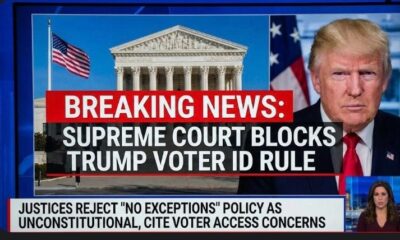
JUST IN: Supreme Court Blocks Donald Trump’s Controversial Attempt to Require Voter ID for Every Single Vote, Rejecting His “No Exceptions” Rule as Unconstitutional


In a dramatic rebuke to executive overreach, the U.S. Supreme Court has blocked Donald Trump’s controversial attempt to require voter identification for every single vote nationwide, rejecting the proposal’s rigid “no exceptions” standard as unconstitutional.
The ruling marks a major legal and political setback for Trump’s long-standing claims about election integrity — and reaffirms the Court’s position that voting access cannot be restricted through blanket federal mandates.
What Trump Tried to Do
Under the proposed rule, every voter — regardless of circumstance — would have been required to present government-issued photo ID to cast a ballot.
No exemptions. No alternatives. No state flexibility.
That meant:
No allowances for elderly voters without updated IDs
No provisional ballots
No accommodations for rural, disabled, or low-income citizens
No respect for state-run election systems
Legal experts immediately warned the policy would disenfranchise millions.
Why the Supreme Court Shut It Down
In its opinion, the Court emphasized three core constitutional violations:
States Control Elections
The Constitution grants states primary authority over election administration. A one-size-fits-all federal mandate crossed that line.
Disproportionate Burden on Voters
The “no exceptions” rule was deemed excessively punitive, especially toward vulnerable populations.
Lack of Evidence
The Court cited the absence of proof that nationwide voter fraud justifies such sweeping restrictions.
One justice wrote that “protecting election integrity does not permit extinguishing the right to vote itself.”
Political Fallout
The decision immediately ignited fierce reactions across the political spectrum.
Voting rights advocates hailed the ruling as a defense of democracy.
Trump allies condemned it as judicial activism.
Election officials warned the proposal would have caused nationwide chaos.
Trump, meanwhile, blasted the decision as proof that the system is “rigged,” doubling down on familiar rhetoric without addressing the constitutional concerns raised by the Court.
What This Means Going Forward
States retain authority to set their own voter ID laws
Federal “no exceptions” mandates are off the table
Courts remain skeptical of policies that restrict access without clear justification
The ruling reinforces a central principle:
Election security cannot come at the cost of constitutional rights.
Bottom Line
This decision sends a clear message — even the presidency has limits, and the right to vote cannot be narrowed by sweeping, inflexible rules.
Democracy, the Court made clear, demands both integrity and access.
👇
Do you think voter ID laws protect elections — or suppress voters? Share your thoughts below.


🏛️ BREAKING: Trump’s Ballroom Dream COLLAPSES — East Wing Demolished, $400M Unaccounted For 😳 Built in 1902. Renovated in 1942. Now? Flattened. A federal judge shut it down. Preservation officials stepped in. And the millions raised? Gone without explanation. 👉 Read the full explosive details before this gets buried ⬇️

U.S. Senator Ed Markey is publicly calling for Donald Trump to be removed from office after controversial remarks — and a small group of Democrats are backing him. But here’s what most people don’t realize: There is NO official action underway, and the 25th Amendment has NEVER been successfully used to remove a president. Is this the beginning of a constitutional showdown… or political pressure in a deeply divided America? 👉 See what would actually have to happen next ⤵️

🚨 JUST IN: Joly DESTROYS Opposition Over SILENCE on Trump’s Tariffs 💥🇨🇦🇺🇸 A fiery intervention from Mélanie Joly has just blown open the political divide after she called out the opposition for staying silent as Trump’s tariff threats escalated. In a sharp, unapologetic takedown, Joly accused rivals of abandoning Canadian workers and industries at a critical moment, while Ottawa moved to defend jobs and supply chains. Insiders say the clash instantly shifted momentum, exposing who’s willing to confront Washington—and who isn’t. What started as quiet avoidance has now become a full-blown accountability fight. 👉 The moment Joly put the opposition on the spot — and why their silence is now backfiring — is spreading fast. 👇👇 Click the full story before the political fallout explodes.

BREAKING: Top Republicans are reportedly complaining that, if the American people demanded the resignation of everyone involved in the cover up of the Epstein Files, the Trump Administration would have “like 3 people left.”

JUST IN: 🇯🇵🇺🇦 Japan has announced $3.8 million in new aid to help Ukraine repair cultural assets damaged during the war.

MILLIONS VOICES RISING — TRUMP IMPEACHMENT PETITION EXPLODES ONLINE A new petition tied to Trump impeachment discussions is reportedly racing toward 1 MILLION signatures, showing just how fired-up and divided Americans are right now. Supporters call it a powerful demand for accountability, while critics warn it could ignite even deeper political chaos. Is this the turning point that forces Congress to act—or just another digital storm? 👉 Click the link to see the petition numbers and what happens next….See more ⤵️

BREAKING: The racist staffer posting from the White House targeting the Obamas got Democrats and Republicans very angry Democrats want Trump impeached immediately for racism and some Republicans said…. Full details ⤵️

😢😭😥 SHOCKING SAD NEWS — JUST 2 MINUTES AGO! The Good Morning Britain studio heartbreakingly confirmed that a tragedy had struck after Christmas. Prince Harry was urgently summoned back to the Palace. Prince William was seen holding his trembling brother. The host announced in a breaking voice: “We are deeply saddened…” See more below 😰👇

JUST IN: TRUMP Could Be JAILED TODAY — Judge Just Drew the Line He Can’t Cross! ▶️ Watch the full moment⤵️

🚨 LIVE TV EXPLOSION: Rosie O’Donnell Drops Stunning Allegations — Trump Fires Back in Fiery Response! 🔥 The studio went tense. The internet erupted. What was said on-air has sparked a political firestorm — and the backlash is spreading fast. 👉 Watch the moment everyone is arguing about — see the full clip before it’s gone.

JUST IN: Supreme Court Overturns Donald Trump’s Immigration Detention Policy, Ruling It Unlawful and Raising Serious Concerns Over ICE Brutality
