
CELEBRITIES
BREAKING: The Supreme Court Overturns Donald Trump’s Immigration Detention Policy, Ruling It Unlawful and Raising Serious Concerns Over ICE Brutality

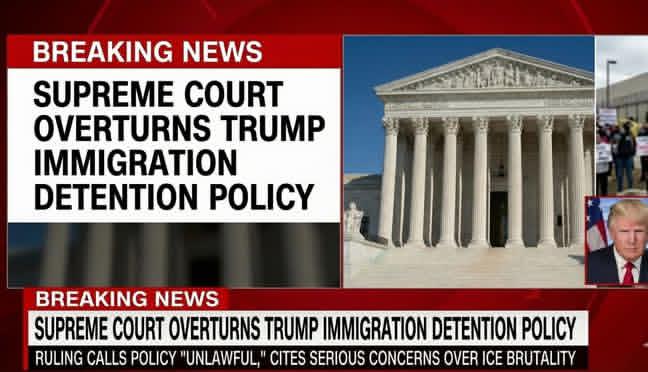
In a landmark decision that reshapes U.S. immigration enforcement, the Supreme Court of the United States has struck down a controversial immigration detention policy tied to Donald Trump, ruling that the framework violated fundamental legal protections and due-process rights.
The ruling delivers a major blow to hardline detention practices that allowed prolonged confinement of migrants with limited access to bond hearings or legal counsel. In its opinion, the Court emphasized that indefinite or near-automatic detention without meaningful judicial review is incompatible with constitutional safeguards.
🔎 ICE Practices Under the Microscope
Beyond the policy itself, the decision intensifies scrutiny of U.S. Immigration and Customs Enforcement (ICE). Justices raised serious concerns about reports of:
Excessive use of force and inhumane conditions
Barriers to attorney access and family contact
Transfers that undermine detainees’ ability to defend their cases
Civil-rights advocates say the ruling validates years of warnings about systemic abuses and signals a turning point for accountability within immigration enforcement.
⚠️ Why This Matters
Immediate Impact: Thousands of detainees may now be eligible for bond hearings or release.
Legal Precedent: The decision curbs executive overreach and reasserts judicial oversight.
Policy Shift: Future administrations face stricter limits on detention authority.
🗣️ Nationwide Reactions
Immigrant-rights groups hailed the decision as a victory for the rule of law, while critics argue it could strain border enforcement. Legal experts predict a wave of reviews, releases, and policy rewrites in the weeks ahead.
📌 Bottom Line:
This ruling marks one of the most consequential immigration decisions in years—redefining detention standards, amplifying concerns over ICE conduct, and reshaping the balance between national security and human rights.



BREAKING: 🇹🇷 President of Turkey, Recep Tayyip Erdoğan: “The world must wake up. What we are witnessing in Gaza is not a war; it is a massacre carried out by a man who has lost all humanity. Netanyahu has surpassed Hitler in cruelty; he has turned a holy land into a cemetery for children while the rest of the world looks the other way out of fear or complicity.”

BREAKING: The Supreme Court Overturns Donald Trump’s Immigration Detention Policy, Ruling It Unlawful and Raising Serious Concerns Over ICE Brutality

🔥 BREAKING NFL NEWS: Broncos star Bo Nix breaks his silence in shocking video response after ‘Little Pig’ comment to a female reporter shocks T.r.u.m.p — NFL superstar condemns disrespect towards women and sparks nationwide outrage. Read Here ⤵️

BREAKING: Petition calling for Trump’s impeachment nears 1,000,000 signatures, topping 900,000 so far Raise your hand if you want Trump Who else believes that the United States would be much better off if Trump and Pam Bondi were removed from office?

JUST IN: Supreme Court Set to Redefine the Limits of Presidential Immunity, Raising Serious Legal Stakes for President Donald Trump’s Second Term

🚨JUST IN: Trump’s Personal Doctor RESIGNS Cites Ethical Concerns ALARMING Details. According to a compilation of reports from multiple news outlets and social media sources. Donald Trump’s personal doctor resigned suddenly — not over his own health, but because he could no longer “lie.” Secret medical notes, including reportedly chilling moments of mental blankness, are said to have crossed an ethical line no physician could ignore. What forced Dr. Shan Connley to walk away from one of the most sensitive roles in the White House? And more importantly: what has the public not been told all along? 👉 Full story in the comments. Source: Compiled from publicly available sources.

🚨 POLL SHOCKER: Americans Flip the Script—More Say Joe Biden Did a Better Job Than Donald Trump 😱 📊 Even Trump-Friendly Polls Show a Stunning Shift… Is the Political Ground Moving AGAIN? 👉 Tap to see the numbers, argue your side, and SHARE before this explodes across Facebook! 🔥 👇 COMMENT: Biden or Trump—who really did better? #BidenVsTrump #BreakingPoll #USPolitics #PublicOpinion

🚨 JUST IN: Canada’s F-35 Deal Turns Into a Sovereignty Showdown After Trump’s New Threats ⚡ What was once a routine defense purchase has erupted into a political flashpoint. After Donald Trump issued fresh threats tied to Canada’s F-35 fighter jet deal, Ottawa is suddenly framing the contract as a matter of national sovereignty, not just military hardware. Officials warn that political leverage over maintenance, upgrades, and data access could leave Canada exposed at a critical moment. Supporters of the deal argue interoperability with the U.S. is essential; critics say dependence now looks like a strategic trap. Allies are watching closely as pressure builds behind closed doors. Is this still about jets—or has Canada stumbled into a battle over who really controls its defense future? 📌 See full story 👇

BREAKING: Supreme Court Set to Withdraw President Donald Trump’s Immunity, Opening the Door for Him to Stand Trial Following Explosive Epstein Revelations and the Controversial Illegal Demolition of the White House East Wing after massive protest in front of White House calling for his impeachment

🚨BREAKING: Former President Removed from White House—Secret Service Facilitates Departure at 3:47 AM At 3:47 a.m. this morning, four deputy U.S. Marshals, three Secret Service agents, and one FBI supervisor entered the Oval Office and informed the former president that the Senate’s conviction had removed him from office. Sixteen minutes later, at 4:03 a.m., he walked out of the White House for the last time — under protest, flanked by marshals, into a standard black government SUV. Not Marine One. Not a presidential motorcade. A standard vehicle. Source: Compiled from publicly available sources. 👉 Full story ⤵️

JUST IN: Supreme Court Overturns Donald Trump’s Immigration Detention Policy, Ruling It Unlawful and Raising Serious Concerns Over ICE Brutality FULL STORY ⤵️
