
CELEBRITIES
UPDATE:Pres. Donald Trump Set to Sign Unprecedented Executive Order Banning Civilian Gun Ownership and Public Display of Firearms after Minnesota Shooting Incident with Federal Agents relating to ICE protest, Setting Up Historic Clash With the Second Amendment and the Bill of Rights

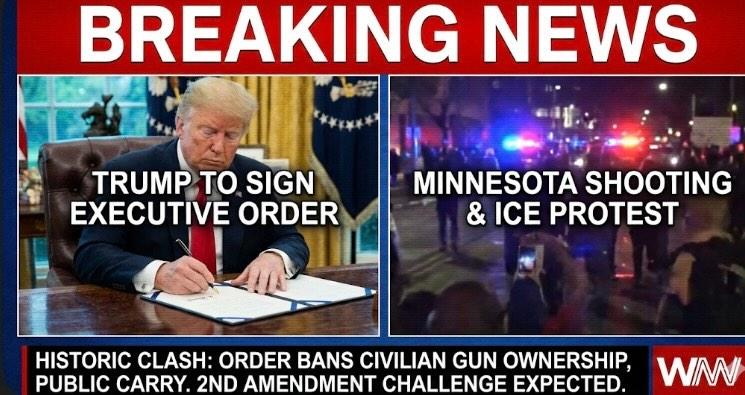
Washington D.C. — In a stunning and controversial development just days after the violent Minnesota shooting involving federal agents and immigration protesters, President Donald Trump is reportedly preparing to sign an unprecedented executive order that would ban civilian gun ownership and public display of firearms nationwide.
Sources close to the administration describe the move as a “national security response” to escalating civil unrest and armed standoffs between federal authorities and demonstrators during immigration enforcement operations tied to ICE. The proposed action, if finalized, would represent the most sweeping federal restriction on firearms in U.S. history — setting up an explosive confrontation with the Second Amendment and sparking what experts predict could be the fiercest constitutional battle in generations.
🔴 Background: Minnesota Shooting Sparks National Shock
The decision follows a chaotic and tragic scene in Minneapolis, Minnesota, where federal agents reportedly exchanged gunfire with armed demonstrators protesting recent ICE raids. At least three people — including one ICE agent and two civilians — were critically injured.
Eyewitness footage circulating online shows protesters scattering as shots rang out near a federal operations site. The confrontation ignited nationwide outrage, prompting the White House to call the situation “a breakdown of civil order fueled by uncontrolled weapon access.”
⚖️ The Executive Order: What It Could Mean
According to early White House drafts reviewed by senior aides, the executive order — tentatively titled “The National Public Safety and Firearm Reform Initiative” — would include:
A nationwide suspension of civilian firearm sales and transfers pending new federal licensing requirements.
A temporary ban on public display or open carry of any firearm, including during protests or political gatherings.
Federal enforcement authority allowing U.S. Marshals and the Department of Homeland Security to confiscate weapons deemed to pose a “credible threat to public safety.”
Administration officials are framing the measure as a “necessary emergency intervention” in response to what they call “rising domestic instability and weaponized political extremism.”
🧭 Historic Clash With the Bill of Rights
Constitutional scholars and civil rights organizations immediately raised alarms, warning that such an order would directly contradict the Second Amendment and trigger sweeping legal challenges.
“This would be an earthquake in American law,” said Georgetown legal analyst Dr. Helen Farrow. “The President cannot unilaterally eliminate the constitutional right to bear arms — not even temporarily — without congressional approval or judicial review.”
Gun rights advocates, including the National Rifle Association (NRA), have vowed to “challenge this order in every court available.”
🔥 Political and Public Fallout
Reaction across the country was immediate and intense. Pro-gun groups called the move “tyrannical,” while some lawmakers praised it as “a courageous stand against the culture of violence.”
Mass protests have already begun forming outside the White House and in several state capitals, with demonstrators waving American flags and signs reading “Defend the Second Amendment” and “Freedom Is Non-Negotiable.”
On Capitol Hill, even some conservative allies expressed concern over the constitutional implications. Senator Mike Rogers (R-TX) stated, “The right to bear arms is not optional — it’s foundational. This executive order will face fierce resistance.”
🕊️ White House Response
A senior administration spokesperson defended the decision, saying the President “is acting within his emergency authority to protect American lives from escalating armed violence.”
“The President believes that the right to live safely outweighs the right to carry weapons in public during a time of national unrest,” the statement read.
The spokesperson did not clarify whether the order would apply indefinitely or be limited to a state of emergency period.
📜 What Happens Next
If signed, the executive order would immediately face injunctions in federal court, setting up a legal battle that could reach the U.S. Supreme Court within weeks. Legal experts say the case could redefine the limits of presidential authority and the meaning of the Second Amendment itself.
“This is not just about guns,” said constitutional scholar Alan Chambers. “It’s about the balance of power between liberty and security — and that battle will shape the future of American democracy.”
🇺🇸 A Nation on Edge
As the nation braces for what may become one of the most divisive chapters in modern history, questions loom large: Can the President override a constitutional right through executive action? And if so, what precedent does that set for the freedoms Americans hold most dear?
For now, the country watches — divided, armed, and uncertain — as the White House prepares to make history.

🚨 BREAKING: Bill Clinton has sharply criticized Donald Trump after a move to block public testimony sparked fresh controversy in Washington. The reaction was swift, pointed, and impossible to ignore—instantly drawing cameras and reigniting debate. Rather than leveling accusations, Clinton focused on process and transparency, questioning why testimony would be restricted at such a critical moment. Observers say the tone was firm but measured, yet the message landed hard: blocking testimony only fuels suspicion and deepens public doubt. This wasn’t political grandstanding—it was a pressure play. When testimony is halted, the narrative shifts from facts to motives. As analysts dissect the fallout and reactions flood social media, many are asking whether this decision will quiet the story—or make it impossible to contain. 👇👇

BREAKING: I hope that he does it. Former president Barack Obama is thinking about Suing Trump for $150 billion for Defamation.

Trump Tried to DISMISS Crockett on Live TV — What She Did Next Made Him CONFESS! ▶️ Watch the full moment⤵️

UPDATE:Pres. Donald Trump Set to Sign Unprecedented Executive Order Banning Civilian Gun Ownership and Public Display of Firearms after Minnesota Shooting Incident with Federal Agents relating to ICE protest, Setting Up Historic Clash With the Second Amendment and the Bill of Rights

🚨JUST IN: 🇬🇧 UK Prime Minister Keir Starmer is continuing with his duties and has no intention of stepping aside, his spokesperson said.

Just hours before the Super Bowl, Bad Bunny sent shockwaves around the world with a confrontation no one expected…. Full details ⤵️

Breaking News:The whole Tennis World Are praying for Richard Williams former tennis coach, Serena Williams dad age 82, Richard suffered from irreparable “brain damage” and “dementia,it is with a heavy heart we shared the Sad News about “King Richard” as he has been confirmed to be…full details below 😱👇

BREAKING: TRUMP BREAKS SILENCE After JIMMY KIMMEL & ARNOLD SCHWARZENEGGER CALL HIM OUT LIVE — UNEXPECTED DOUBLE HIT SENDS STUDIO INTO CHAOS…full details ⤵️

JUST IN: Donald Trump Orders Complete Demolition of the Kennedy Center, Approves $12 Billion Federal Plan to Tear Down and Rebuild the Iconic National Arts Complex From the Ground Up

JUST IN: Bad Bunny Files Stunning $500 Million Lawsuit Against Donald Trump, Claiming The President’s Super Bowl LX Halftime Remarks Were Made With “Actual Malice” and it’s Causing Severe Reputation Damage

🚨Obama Breaks Silence, Delivers Sharp Warning About Trump What It Means Now⚡….See more ⤵️
