
CELEBRITIES
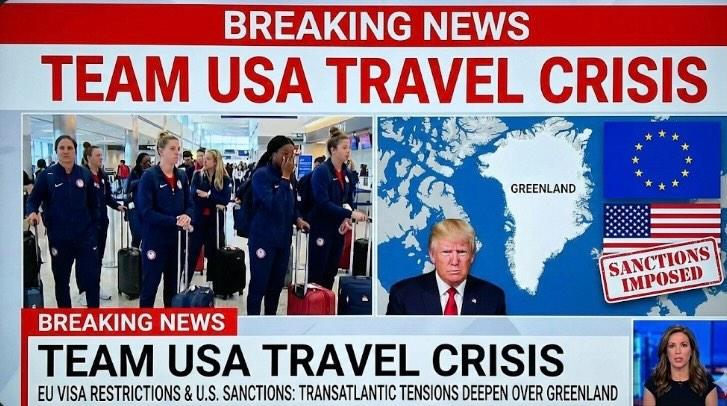
UPDATE: The Team USA Olympic Athletes Report Severe Travel Difficulties as EU Visa Restrictions and Sanctions on the U.S. Deepen Transatlantic Tensions Over Donald Trump’s Greenland Ambitions

Overview
In an unfolding diplomatic dispute that is straining relations between the United States and the European Union, members of the U.S. Olympic team report significant travel difficulties when preparing to travel to Europe for competitions and training ahead of the upcoming Olympic Games. According to recent social-media reports, these travel obstacles are being linked to tighter EU visa scrutiny and reciprocal sanctions, which are part of an escalating political standoff tied in part to President Donald Trump’s controversial push to assert U.S. influence over Greenland. �
Threads +1
Allegations of Travel Problems
While official statements from the U.S. Olympic & Paralympic Committee (USOPC) are still outstanding, several athletes and support staff have taken to social platforms reporting delays at EU consulates, longer-than-expected visa processing times, and confusing entry requirements that they say jeopardize their ability to attend training camps, qualifying events, and pre-Games tournaments. Many describe the situation as a bureaucratic burden, rather than simple travel inconvenience. �
Threads
These difficulties come at an already congested time for international travel: the EU’s Schengen Entry/Exit System (EES), an automated border control system for third-country nationals, has been rolling out fully across the bloc and is expected to be in place by early April 2026, replacing historic passport stamp procedures with digital tracking that some travelers find unfamiliar and slow. �
Wikipedia
What’s Behind the Visa Tension?
EU’s Security and Visa Strategy
In the context of broader geopolitical uncertainty, the European Union has been reassessing visa processing guidelines and foreign travel policies as part of its new visa strategy and migration policy reforms, which include potential visa suspensions or tighter scrutiny in response to “hostile actions by third countries” that could undermine EU security — a category some interpret to include punitive measures by the U.S. government. �
Fragomen
Reciprocal Sanctions and EU–U.S. Dispute
Relations between Brussels and Washington have been increasingly strained by a series of visa bans and sanctions imposed by both sides. For example, the United States recently imposed visa restrictions on several high-profile European figures, including a former European Commissioner for the EU internal market, in a dispute over digital rules and alleged censorship issues. These U.S. sanctions drew sharp criticism from EU leaders, including French President Emmanuel Macron, who described the measures as “intimidation” and an attack on European sovereignty. �
Reuters +1
Though these actions were not specifically targeted at athletes, officials say they contribute to an atmosphere of mistrust that may complicate routine diplomatic cooperation — including the processing of athlete visas and authorizations.
Greenland Controversy Deepens Dispute
A significant backdrop to this tension is President Trump’s 2025–26 attempts to assert U.S. influence over Greenland, a Danish territory with historic and legal ties to the EU. Trump’s public statements that Greenland “may be something we should seriously look at owning” sparked protests in Denmark and Greenland, condemnation from EU states, and threats of retaliatory economic measures — including potential tariffs against EU allies that oppose the idea. �
Wikipedia
That conflict prompted Operation Arctic Endurance, a European defense posture exercise, and indications that several EU countries were considering sanctions and trade reprisals over the U.S.’s hardline approach. �
Wikipedia
While President Trump later backed down from military or tariff threats during talks at the World Economic Forum, the episode intensified mistrust and fed a broader narrative in EU capitals that U.S. policy under the Trump administration is increasingly unilateral — complicating cooperation on everything from trade to visa facilitation. �
Wikipedia
Official Responses & Athletics Exemptions
It’s worth noting that the U.S. State Department has carved out specific visa exemptions for athletes, coaches, and staff participating in major sporting events such as the World Cup or Olympic Games, to ensure they are not subject to broad travel bans that apply to nearly 40 countries. However, these exemptions do not cover all support personnel, spectators, media, or ancillary travel needs, and do not address reciprocal EU-side policy changes. �
AP News
What This Means for the Olympic Team
For Team USA athletes, the uncertainty has two immediate impacts:
Practical hurdles — changing visa requirements and digital border systems are delaying travel plans, potentially disrupting training and competition schedules. �
Threads
Political climate — the wider diplomatic tensions are creating an unpredictable environment for U.S. delegations travelling abroad — not just athletes, but coaching staff, families, and officials.
Officials from USOPC and the U.S. State Department have yet to publicly confirm the full nature or scale of these difficulties, and it is unclear whether the EU’s visa policy changes are directly aimed at U.S. nationals or are a by-product of broader, security-oriented migration policy reforms. However, with global competition calendars tightening and the Olympics approaching, the issue remains a top concern for athletes and sports administrators alike.

🚨5 MIN AGO : Trump STUNNED as 60 Senators BLOCK His Agenda at the LAST MINUTE — Power Play COLLAPSES ⚡🏛️ Washington erupted after a coalition of 60 U.S. Senators moved at the eleventh hour to block Donald Trump’s proposed legislation, delivering a stunning blow to his agenda. The last-minute maneuver caught Trump allies off guard and instantly shifted the balance on Capitol Hill. Analysts say the move signals deep resistance, weakening leverage, and growing cracks in support, leaving Trump scrambling for a response as momentum slips away…. Full details in👇

JUST IN: Supreme Court Blocks Donald Trump’s “Save Act,” Rules It Violates U.S. Constitution, Conflicts With Voting Rights Act, and Imposes Unreasonable Burdens on Voters

UPDATE: The Team USA Olympic Athletes Report Severe Travel Difficulties as EU Visa Restrictions and Sanctions on the U.S. Deepen Transatlantic Tensions Over Donald Trump’s Greenland Ambitions

🚨Trump PANICS after MASSIVE LOSS…IN TEXAS!!!⚡ Donald Trump is showing clear signs of panic as Texas begins to shift politically. In a stunning special election runoff for Texas State Senate District 9, a Democratic candidate flipped a seat that hadn’t gone blue since 1991—winning by 14 points in a district Trump had carried by 17. This represents a 31-point Democratic overperformance, despite Republicans outspending Democrats by $2.5 million. Trump had loudly endorsed the MAGA candidate before the election, calling her a “phenomenal” and “true MAGA warrior.” But after her crushing defeat, Trump suddenly claimed he didn’t know about the race and had “nothing to do with it,” contradicting his own public statements. The result highlights a broader trend: independents and Republicans are crossing over, while Democrats are gaining momentum by focusing on workers’ rights, affordability, and healthcare instead of culture wars. Additional Democratic wins in Texas House races have narrowed the GOP’s majority in Congress to a single vote. Taken together, these developments suggest Texas is becoming competitive—and a potential blue tsunami could spell serious trouble for Trump and MAGA Republicans in upcoming elections…👇

JUST IN: House Democrats are said to be only five votes short of moving forward with Trump’s impeachment, as political pressure rises and a single vote could shift the outcome in Washington.

🔥 BREAKING: TRUMP ERUPTS After BARACK OBAMA DROPS A BOMBSHELL LIVE ON TV — SHOCK REVELATION SENDS THE STUDIO INTO TOTAL CHAOS ⚡ It was pure live-TV mayhem as Barack Obama calmly detonated a political bombshell in real time — dismantling a long-standing narrative around Donald Trump with precision and restraint. Obama opened with a measured tone and a slight smile, lining up Trump’s own claims like receipts. The audience chuckled at first — assuming it was setup. Then the reveal landed, and the mood shifted instantly. One line hit and the studio went dead silent — before erupting in gasps, laughter, and applause. Obama didn’t raise his voice. He didn’t mock. He simply walked through the facts, step by step, turning years of bravado into a clean, clinical takedown that reframed the entire moment. Each sentence tightened the vice, exposing contradictions and collapsing the myth in real time. According to insiders, Trump was watching live — and completely LOST IT. One source says he “went ballistic,” pacing, shouting, and demanding the network be punished immediately. The meltdown reportedly lasted nearly an hour. The clip has since exploded online, with millions calling it “the most devastating Obama moment ever aired live.” Political commentators say Obama didn’t just challenge Trump — he broke the narrative. 👇 The full Obama segment is now trending worldwide — watch the viral bombshell that sent Trump into meltdown before it’s pulled offline… 👇🔥

🚨 BREAKING: UK PM Keir Starmer Issues SHOCK Apology to Epstein Victims — Admits He Was “Misled” as Top Envoy Is FIRED 👉 Watch the moment trust shattered — details unfolding now

JUST IN: Amnesty International Submits Petition Seeking Possible Imprisonment and Asset Freezes for Elon Musk Over Alleged Foreign Election Interference, Also Calls for Donald Trump’s Impeachment and Arrest, Citing Allegations of War Crimes, ICE Brutality, Free Speech Abuse, and Epstein-Related Concern

You won’t believe the chaos that just erupted on the New Heights set! 😱 Travis Kelce had a major “oops” moment when he accidentally crushed Taylor Swift’s absolute favorite piece of furniture. The look on his face is priceless! 🪑 See the hilarious moment Taylor caught him red-handed in the comments! 👇

🚨 JUST NOW: TRUMP IMPEACHMENT 3.0 EXPLODES: 212 LAWMAKERS SIGN RESOLUTION — Shocking Twists Ahead as Chaos Erupts & Secrets Threaten to Unravel Everything! 💥 In a shocking turn of events, Donald Trump’s third impeachment has detonated like a Hollywood blockbuster bomb, with 212 lawmakers signing a blistering resolution accusing him of abuse of power and election meddling. What started as hushed Capitol whispers has erupted into a full-scale congressional war, fueled by explosive evidence reportedly linking the president to shadowy backroom deals that could topple his empire. Insiders claim the resolution was rushed after leaked memos from White House aides revealed desperate attempts to quash probes, leaving Trump fuming at Mar-a-Lago and blasting it as a “rigged betrayal” on Truth Social. Fans can’t believe the betrayal as 47 Republicans break ranks, while the public splits in fury—trending across platforms like X and TikTok with memes and heated debates exploding online. The internet can’t stop talking about this viral impeachment thriller—dive into the full resolution before shocking secrets get buried forever!👇

“Wake up, Jeff.” — Travis Kelce suddenly announced that he would pull all of his collaborations and brand partnerships from Amazon, criticizing what he described as Jeff Bezos’ quiet alignment with Donald Trump. The statement quickly became an ultimatum that stunned both Bezos and the public. Full story below👇👇👇
