
CELEBRITIES
The U.S. House and Senate Secure the Necessary Votes to Pass the Bipartisan NATO Unity Protection Act, Explicitly Blocking Donald Trump From Using Military Force to Seize Greenland, a Danish Territory Under NATO Protection…. Full details ⤵️

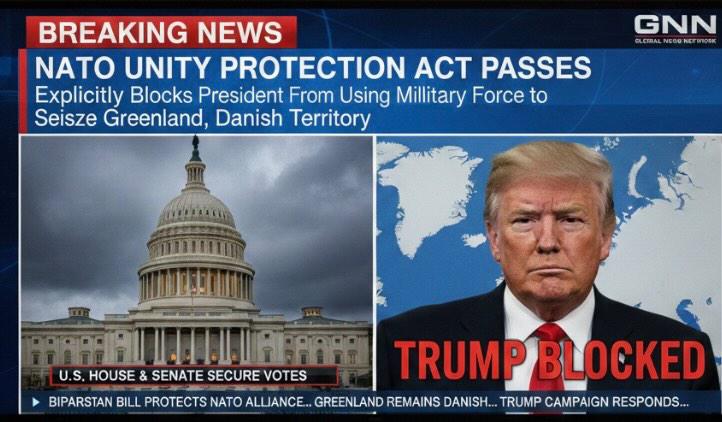
In a rare and decisive show of bipartisan unity, leaders in both the U.S. House of Representatives and the Senate have now secured the necessary support to advance and pass the NATO Unity Protection Act, landmark legislation designed to explicitly prevent Donald Trump from using U.S. military force against Greenland, an autonomous Danish territory protected under NATO.
This move represents one of the strongest congressional rebukes yet of Trump’s increasingly aggressive rhetoric toward U.S. allies—and a clear signal that Congress is prepared to draw a hard constitutional line.
🔍 WHAT TRIGGERED THIS MOMENT?
The urgency behind the bill follows a wave of international alarm after Donald Trump refused to rule out military action to seize Greenland, citing its strategic Arctic importance. His comments sent shockwaves through NATO capitals, as Greenland is:
An autonomous territory of Denmark
Fully covered by NATO Article 5
Home to critical U.S. and allied military infrastructure already governed by treaty
What alarmed lawmakers most was not just the rhetoric—but the implication that a U.S. president could contemplate force against a NATO ally without congressional authorization.
That was the red line.
📜 WHAT THE NATO UNITY PROTECTION ACT DOES
The NATO Unity Protection Act is blunt, surgical, and legally powerful. It:
✔ Prohibits the use of any federal funds for military action against a NATO member or its territory
✔ Explicitly blocks invasion, occupation, annexation, blockade, or seizure of NATO-protected land
✔ Applies directly to Greenland as part of the Kingdom of Denmark
✔ Reinforces Congress’s constitutional authority over war and military funding
✔ Prevents any president—Trump included—from bypassing Congress through executive action
In simple terms: no money, no troops, no war.
🏛️ BIPARTISAN SUPPORT — AND THE VOTES ARE THERE
Unlike many partisan standoffs, this legislation has drawn broad bipartisan backing:
Republicans alarmed by the erosion of NATO unity
Democrats determined to enforce constitutional war powers
Foreign policy hawks warning of catastrophic alliance fallout
National security experts stressing the dangers of intra-NATO conflict
Multiple congressional leaders have now confirmed that the House and Senate both have sufficient votes to pass the bill, with momentum strong enough to withstand procedural delays—and potentially even a veto confrontation.
This is not symbolic. This is operational power.
🌍 WHY THIS MATTERS — BEYOND GREENLAND
This bill is about far more than one territory.
If a U.S. president were allowed to use force against a NATO ally:
NATO itself could fracture
Article 5 would be weakened or rendered meaningless
Adversaries like Russia and China would exploit the chaos
U.S. global credibility would suffer historic damage
Congress is acting now to prevent a precedent that could collapse decades of alliance stability.
As one senior lawmaker put it:
“You don’t defend democracy by threatening your allies with tanks.”
⚖️ CONSTITUTIONAL AND LEGAL IMPLICATIONS
The legislation reinforces long-standing principles:
Only Congress can authorize war
The president cannot unilaterally attack allied nations
NATO treaties are binding commitments, not political suggestions
Legal scholars note that even contemplating force against Greenland would violate:
The U.S. Constitution
The War Powers Resolution
International law
NATO treaty obligations
This bill removes ambiguity—and excuses.
🔮 WHAT HAPPENS NEXT?
Next steps include:
Final floor votes in both chambers
Rapid passage given bipartisan alignment
Transmission to the president’s desk
If vetoed, Congress retains the option of override, depending on margins
Regardless of the final procedural path, one thing is now clear:
👉 Congress has taken control of the issue.
🧨 THE BOTTOM LINE
For the first time in this crisis, the message from Washington is unmistakable:
Greenland is not a bargaining chip.
NATO is not optional.
And no president is above the law.
The NATO Unity Protection Act draws a firm boundary around America’s alliances—and sends a global signal that Congress will not allow reckless military adventurism to rewrite international order.

The U.S. House and Senate Secure the Necessary Votes to Pass the Bipartisan NATO Unity Protection Act, Explicitly Blocking Donald Trump From Using Military Force to Seize Greenland, a Danish Territory Under NATO Protection…. Full details ⤵️

EMERGENCY POWER DECLARES EMERGENCY POWERS as REPUBLICANS PUSH BACK!!! — White House Meltdown Ignites, Party Revolt Explodes in Escalating Power Struggle! In a shocking turn of events, what started as a tense late-night Oval Office session detonated into open rebellion when President T̄R̄UMP invoked sweeping emergency powers, only for key Republicans to immediately turn against him in a stunning bipartisan backlash. T̄R̄UMP reportedly erupted in fury behind closed doors, branding defectors “disloyal cowards,” while GOP senators issued fiery public rebukes—insiders claim leaked memos reveal frantic White House calls to whip votes that collapsed spectacularly, fueling whispers of a crumbling inner circle. The confrontation exploded online, fans can’t believe the rapid fracture, reportedly trending across platforms as outrage surges coast to coast. The full clip is going viral—watch⤵️

Global Icon Taylor Swift Claims U.S. Democratic Institutions Have “Indulged Trump’s Anti-Democratic Behavior,” Stating the Congress and Supreme have Totally Betrayed American Citizens by not Impeaching the Fascist…. Full details ⤵️

💥 TRUMP UTTERLY DESTROYED as JD VANCE UNLEASHES SHOCKING IMPEACHMENT BOMBSHELL — Inner Circle Betrayal Explodes, Empire in Freefall, Jaw-Dropping Revelations Fuel Escalating Scandal and Nationwide Political Armageddon! ⚡ In a shocking turn that’s tearing through Washington like a tabloid tornado, JD VANCE has reportedly dropped a mind-blowing IMPEACHMENT BOMBSHELL that leaves TRUMP utterly destroyed—exposing alleged high-level betrayals in a explosive testimony that’s got insiders reeling. What started as alliance whispers has detonated into full-blown warfare, with Vance flipping the script on his former boss amid mounting probes. Trump’s camp is in meltdown mode, with the ex-president raging on social media and loyalists scrambling for cover—fans can’t believe the backstab, while critics cheer the chaos. Outrage exploded online, trending across platforms with viral clips and fiery debates dividing the nation. But insiders claim a leaked audio from behind closed doors reveals even darker twists, with Vance allegedly holding back more damning dirt. The full bombshell is going viral, and the internet can’t stop talking—watch before it’s taken down and see if this betrayal seals Trump’s doom!…. full details ⤵️

BREAKING NEWS: A wave of shock has rippled through the global hockey world as reports confirm that Lauren Kyle, the beloved wife of NHL superstar Connor McDavid, is currently in critical condition. WATCH MORE⤵️

Trump’s POWER ENDS as Supreme Court KILLS Immunity A historic legal earthquake reportedly rocked Washington after the Supreme Court moved to eliminate immunity protections linked to Donald Trump, fundamentally reshaping his legal exposure. Legal analysts say the decision strips away a core shield Trump has relied on for years, opening the door to direct accountability like never before. The ruling sent shockwaves through political and legal circles, with allies scrambling and critics calling it a constitutional reset. As immunity collapses and consequences loom, one question now dominates the nation: Is Trump finally subject to…. full details ⤵️

🚨 TRUMP PANICS as JUDGE CORNERS HIM: TESTIFY OR GO TO JAIL ⚡ “This Is No Longer a Warning” — See What Happens Next 👇

🚨 BREAKING: Canada Draws a WAR LINE Against Trump — Signals Military Action If Greenland Is Touched Allies are no longer bluffing… this just crossed a terrifying threshold…. full details ⤵️

🔥 TOP GOP LEADERS DROP THE HAMMER: Republicans WARN Trump a Greenland INVASION Would END His Presidency Immediately — “This Is the Finish Line” ⚠️ 👉 See why allies are turning into enemies⤵️

Capitol Hill ERUPTS as Lawmakers DEMAND Trump RESIGN Breaking political chaos reportedly exploded across Capitol Hill as lawmakers openly demanded that Donald Trump resign, triggering a fierce backlash and emergency discussions behind closed doors. Multiple figures are now breaking ranks, citing escalating legal risks, institutional damage, and collapsing confidence. Is Trump’s political future unraveling in real time? 🔥 👇 Full details 👇

“I won’t bring my wife back unless she’s treated like a Queen.” 😤 — Harry’s shock UK comeback threat ignites palace chaos as whispers swirl of royal-level security, red-carpet demands, and a Sussex return Buckingham Palace never planned for. Insiders hiss this isn’t a visit — it’s an ultimatum. Is Meghan staging her most explosive homecoming yet… or daring the Crown to bow first?… WATCH BEFORE THE STORY GETS BURIED 👇👇— Full Details Below👇
